
The Leadership Reckoning in the UAE: Why Gulf Organizations Must Close the Trust Gap to Secure Talent
The modern workplace in the UAE is facing a quiet crisis. It is not merely about return-to-office mandates or hybrid work models. It is about Credibility.
As the UAE solidifies its position as a global hub for business and innovation, the internal dynamics of its organizations are under scrutiny. The nation invests heavily in national talent development and attracting global professionals . However, if employees look at their immediate managers and feel distrust, these investments fail to yield returns.
At Green Line Pioneers, we have analyzed the latest behavioral data regarding workplace leadership. The numbers paint a stark picture. Employees across the Emirates are losing faith in the people steering the ship.
If you are a senior HR leader or a C-suite executive in Dubai, Abu Dhabi, or the wider GCC, this is the gap that will determine your organization’s survival in the age of AI and constant disruption.
Here is the reality check every organization in the Gulf must face right now.
The Current State of Play: The Data Does Not Lie
The gap between leadership perception and employee reality is wider than ever. Academic research within the UAE context indicates that while organizations show strengths in relationship-building, they often face weaknesses in decision-making and leadership effectiveness . Consider these statistics.
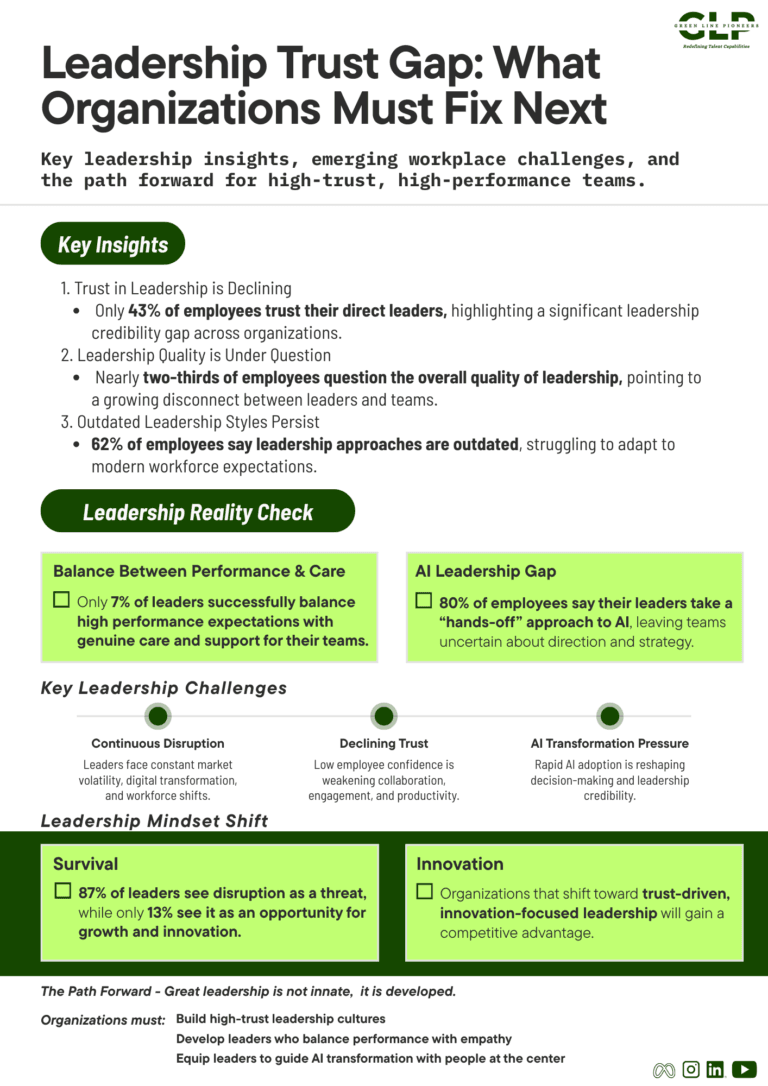
Trust is at an all time low. Only 43 percent of employees trust their direct leaders. When trust dips below the 50 percent threshold, collaboration and psychological safety vanish. In a diverse, multicultural workforce like the UAE, where clear communication is vital, this trust deficit is dangerous .
The Quality Gap. Nearly two thirds of employees question the overall quality of leadership. This indicates a fundamental disconnect between the C suite and the front lines. This disconnect is particularly harmful in the UAE’s fast-moving markets where agility is required.
Stuck in the Past. 62 percent of employees believe leadership styles are outdated. The command and control era is over, but many leaders have not adapted to the modern purpose driven workforce that includes young Emirati graduates and experienced expatriates alike.
The Performance Versus Care Paradox
There is a common misconception that leaders must choose between being tough on results or being kind to people.
Our research shows that this is a false choice. However, it is one that 93 percent of leaders are getting wrong.
Only 7 percent of leaders successfully balance high performance expectations with genuine human care.
The rest either burn out their teams chasing numbers or foster a nice culture that lacks accountability. In the UAE, where the national agenda pushes for high performance and innovation , leaders cannot afford to neglect the “care” component without risking retention.
The Elephant in the Room The AI Leadership Vacuum
We are currently witnessing the fastest technological shift in history, yet leadership is absent.
80 percent of employees report that their leaders are taking a hands off approach to AI.
By staying silent or passive, leaders are creating an environment of uncertainty. If your team does not know the strategy regarding AI, they will either fear it or misuse it. With the UAE investing heavily in AI and tech talent, a “hands-off” leader becomes the biggest bottleneck to digital transformation.
The Triple Threat Why Leaders Are Struggling
Leaders today are not failing because they are incompetent. They are failing because they are trying to solve three distinct challenges simultaneously without a modern playbook.
First, Continuous Disruption. Market volatility and workforce shifts are the new norm, not the exception.
Second, Declining Trust. Low confidence is a tax on speed. When trust is low, every decision slows down.
Third, AI Transformation. The rapid adoption of AI is reshaping decision making. If leaders do not guide it, they lose credibility.
The Mindset Shift From Survival to Innovation
How leaders perceive the current climate dictates their success.
We are seeing a massive divide.
The 87 percent Majority. These leaders view disruption as a threat. This leads to defensiveness, hoarding information, and burnout.
The 13 percent Minority. These leaders view disruption as an opportunity. They are agile, curious, and ready to innovate.
Organizations that shift from a Survival mindset to an Innovation mindset will dominate the next decade in the Middle East.
The Path Forward for UAE Organizations
The era of the natural born leader is over. In a complex world, leadership must be built intentionally.
At Green Line Pioneers, we believe that closing the trust gap requires a surgical approach. Here is how organizations in Dubai and Abu Dhabi must pivot.
Build High Trust Leadership Cultures
Trust is not a soft metric. It is a hard economic driver. We must move from managing people to creating environments where people feel safe enough to take risks. This is directly tied to how you bring people into the organization. If your talent acquisition strategies focus only on skills and ignore a candidate’s capacity for empathy, you will continue to hire managers who erode trust.
Redefine the High Performer
Stop promoting purely based on results. Promote leaders who can balance Performance with Empathy. The 7 percent who can do this are your future executives. You need to identify and scale them. Your recruitment partners must be adept at sourcing these rare profiles to ensure your pipeline is filled with leaders, not just managers.
Equip Leaders for the AI Era
Leaders do not need to be coders. However, they need to be Curators. They must guide AI transformation with humans at the center. A hands off approach is no longer acceptable. Finding leaders who possess this digital fluency requires a specialized approach to acquiring top talent that understands both the local market and global tech trends.
Leverage UAE Specific Frameworks
The UAE government has provided clear blueprints for success, such as the national strategy to attract and retain global talent . Organizations must align their internal leadership development with these national visions. Leaders must understand the nuances of the local labor law, the expectations of a diverse workforce, and the strategic goals of the nation to truly inspire their teams .
The Bottom Line
The organizations that win the war for talent in the UAE will not be the ones with the biggest offices or the highest salaries. They will be the ones who close the Leadership Trust Gap. They will be the ones where employees feel guided through change, supported in their growth, and trusted to innovate.
Is your leadership team ready to meet the moment? Is your recruitment strategy designed to find leaders who can build trust, or just managers who can fill a seat?
At Green Line Pioneers, we specialize in developing human centric leaders and connecting organizations with the qualified talent needed to navigate disruption without losing their people.
Contact Green Line Pioneers today. Let us help you build a team that is truly ready for the future.
Green Line Pioneers – Your Partner in Strategic HR Consultancy in the UAE
Phone: +971 586-818-756
Email: info@greenlinepioneer.com
Website: www.greenlinepioneer.com
Frequently Asked Questions (FAQs):
The UAE has a uniquely diverse workforce, mixing Emirati nationals with expatriates from dozens of countries. This requires leaders to have high cultural intelligence and empathy. A trust deficit here leads to higher turnover and a failure to integrate diverse perspectives, which directly harms innovation . Furthermore, with national agendas pushing for high performance, a lack of trust prevents teams from taking the necessary risks to innovate.
Poor leadership reputation spreads quickly. If candidates in the Dubai job market hear that managers at a certain firm do not support their teams or are “outdated,” they will refuse offers, even for high salaries. Effective talent acquisition now requires selling the leadership culture as much as the role itself. If your leaders lack empathy, retention suffers, forcing you back into a costly hiring cycle.
AI is forcing leaders to manage things they do not fully understand. The research shows 80% of leaders are “hands-off” with AI. In a tech-forward nation like the UAE, this creates a credibility issue. Team members look to leaders for a roadmap on using AI tools, and when none is provided, they feel directionless and anxious about their job security.
It is the false belief that a leader must be either “tough” on metrics or “soft” on people. The data shows that only 7% of leaders can do both effectively. In the UAE market, where the pace is fast, leaders often lean too heavily on performance pressure, burning out the very teams they need to retain.
HR consultancies provide the external expertise to audit current leadership styles, implement coaching programs (which research shows significantly impacts commitment in the UAE context ), and redesign talent acquisition frameworks to prioritize emotional intelligence and adaptability alongside technical skills.
Causes include a lack of transparent communication during times of change (like digital transformation), perceived unfairness in performance management, and a failure by leaders to adapt their style to a younger, more purpose-driven workforce.
Beyond standard KPIs, companies should measure “trust metrics” through anonymous pulse surveys, track retention rates of high performers under specific managers, and analyze internal mobility. If people are not moving up or staying long under a certain leader, there is a trust issue.

Green Line Pioneers
Redefining Talent Capabilities
Explore us on Social Media