
People Operations vs. Traditional HR: Where Does Your Organization Stand? (And Why It Matters)
The world of work is evolving at breakneck speed. Remote and hybrid models, shifting employee expectations, the demand for continuous learning, and the relentless pace of technological change are forcing organizations to rethink how they manage their most valuable asset: their people. At the heart of this transformation lies a critical question: Is your HR function merely maintaining compliance, or is it actively constructing your competitive advantage?
The answer often hinges on whether your organization leans towards Traditional HR or embraces the strategic mindset of People Operations (People Ops). While both are essential for organizational function, their focus, impact, and ultimate value differ dramatically. Let’s dissect this crucial divergence.
The Shifting Landscape: From Policy Enforcer to Growth Accelerator
For decades, HR was primarily seen as the department of rules, paperwork, and payroll. Its core mission was ensuring legal compliance, managing administrative tasks, and resolving employee issues – often reactively. This is the domain of Traditional HR.
However, forward-thinking organizations recognize that people strategy is business strategy. Enter People Operations. This evolved approach moves beyond administration to become a proactive, data-driven partner focused on optimizing the entire employee experience to directly drive organizational growth, innovation, and cultural health.
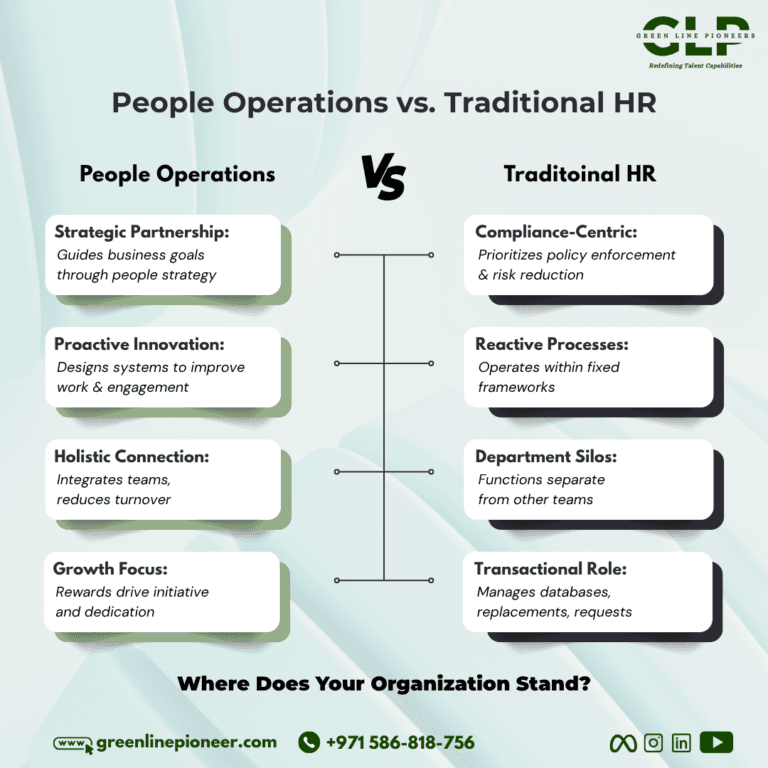
People Operations vs. Traditional HR: A Detailed Breakdown
Here’s a closer look at how these two models operate across key dimensions:
- Core Focus & Purpose:
- Traditional HR: Compliance-Centric. Priority #1 is adhering to labor laws, enforcing company policies, managing legal risks, and ensuring administrative accuracy. Success is measured by avoiding lawsuits and processing transactions efficiently.
- People Operations: Growth-Centric. Priority #1 is aligning people strategy with overarching business goals to drive performance, innovation, and market differentiation. Success is measured by talent outcomes (retention, engagement, productivity) and their impact on business results (revenue, market share, innovation rate).
- Approach to Strategy:
- Traditional HR: Transactional & Reactive. Primarily responds to requests (hiring, payroll changes, policy queries, employee relations issues) within established, often rigid, frameworks. Strategy, if present, tends to be HR-siloed.
- People Operations: Strategic & Proactive. Acts as a strategic partner to leadership. Anticipates future workforce needs, designs systems (recruitment, development, engagement) based on data and business objectives, and proactively identifies opportunities to enhance the employee lifecycle. Connects talent development directly to organizational outcomes.
- Innovation & Problem Solving:
- Traditional HR: Process-Bound & Reactive. Solutions are often constrained by existing policies and procedures. Innovation is limited; the focus is on maintaining established systems. Addresses problems after they arise.
- People Operations: Proactive Innovation. Actively seeks out friction points in the employee experience. Designs and implements new programs, tools, and policies (e.g., flexible work models, personalized L&D, predictive analytics for retention) to address future needs, boost engagement, and increase commitment. Focuses on preventing issues and creating an environment where talent thrives.
- Organizational Integration:
- Traditional HR: Departmental Silos. Often operates separately from core business functions (like Sales, Engineering, Product). Can be perceived as an administrative hurdle or “policy police” by revenue-generating teams.
- People Operations: Holistic Connection. Actively works to remove barriers between departments. Embeds people practices within business units, fostering collaboration and a unified company culture. Understands the needs of all teams and ensures people strategies support them cohesively.
- Impact on Culture & Retention:
- Traditional HR: Limited Cultural Influence. Culture is often seen as organic or separate from HR’s core duties. Focuses on resolving cultural issues reactively. Retention efforts are typically transactional (exit interviews, backfilling roles).
- People Operations: Culture Architect. Actively shapes and nurtures a strong, positive company culture through intentional programs, communication, leadership development, and feedback mechanisms. Focuses on the entire employee experience to significantly strengthen culture and cut attrition. Structures rewards, recognition, and development to inspire ownership and long-term contribution.
The Critical Question: Compliance or Competitive Differentiation?
So, where does your organization stand?
- Is your HR function primarily maintaining compliance, managing transactions, and reacting to problems within predefined boundaries? (This is Traditional HR.)
- Or, is it actively constructing competitive differentiation by attracting, developing, engaging, and retaining top talent in ways that directly accelerate business growth, foster innovation, and create a magnetic culture? (This is People Operations.)
Why the Shift to People Operations is Imperative
The cost of sticking purely with a Traditional HR model is high in today’s environment:
- Higher Turnover: Disengaged employees leave.
- Stifled Innovation: Rigid structures hinder adaptability and new ideas.
- Recruitment Challenges: Inability to attract top talent seeking modern, empowering environments.
- Poor Employer Brand: Being known as a bureaucratic, compliance-heavy organization.
- Missed Strategic Opportunities: HR insights aren’t leveraged for business growth.
People Operations isn’t about eliminating necessary compliance; it’s about elevating the function’s strategic value. It’s about viewing employees not as costs to manage, but as invaluable assets whose full potential can be unlocked to drive the organization forward.
Taking the Next Step with GreenLine Pioneer
The transition from Traditional HR to strategic People Operations requires vision, expertise, and a tailored approach. At GreenLine Pioneer, we specialize in building HR strategies for tomorrow’s workforce. We help organizations:
- Diagnose their current HR/People Ops maturity.
- Develop data-driven people strategies aligned with business goals.
- Design and implement modern talent acquisition, development, and retention programs.
- Foster a thriving, connected company culture.
- Equip HR teams with the skills and mindset to become strategic partners.
Ready to move beyond compliance and build a people function that drives real competitive advantage?
Contact GreenLine Pioneer today to start your transformation journey.

Green Line Pioneers
Redefining Talent Capabilities
Explore us on Social Media