
Skills Gap Analysis: A Practical Framework for Building a Future-Ready Workforce in the UAE
Organizations across the UAE are facing a growing disconnect between the skills they need and the capabilities their workforce currently has. This gap is not just a talent issue. It is a business risk that affects productivity, innovation, and long-term growth.
A structured skills gap analysis provides a clear way to identify these gaps and take focused action. For companies in Dubai, Abu Dhabi, and the wider Emirates, this framework is essential for building a future-ready workforce while meeting national objectives like Emiratisation.
Why Skills Gaps Are Becoming a Business Priority in the UAE
The pace of change in technology, customer expectations, and business models is accelerating. Roles are evolving faster than traditional hiring and training cycles can keep up. According to multiple workforce studies, a significant percentage of organizations report difficulty in finding candidates with the right skills. At the same time, internal teams often lack visibility into existing capabilities, making it harder to redeploy or develop talent effectively.
This creates three key challenges for UAE employers:
- Reduced productivity due to capability mismatches
- Increased hiring costs and longer time to fill roles
- Missed opportunities for innovation and growth
Addressing these challenges requires a structured, data-driven approach. Central to this is a commitment to continuous learning and development, which helps organizations close skill gaps from within.
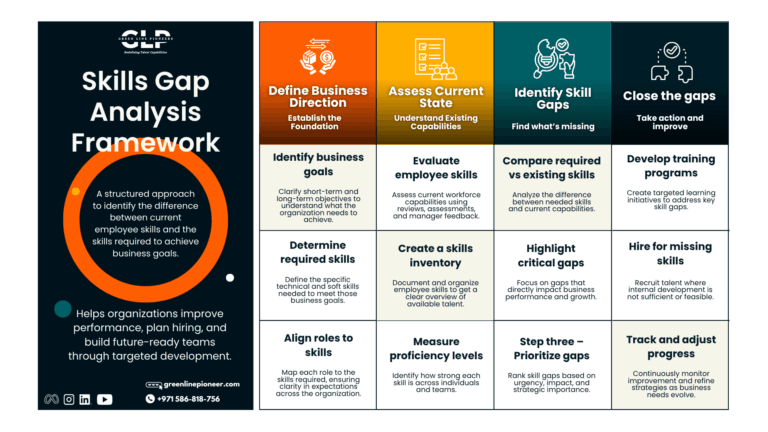
Step One: Define Business Direction
A skills gap analysis starts with clarity on business goals. Without this, any assessment of skills becomes disconnected from actual needs.
Organizations need to answer:
- What are the strategic priorities for the next one to three years?
- Which roles will be critical to achieving these goals?
- What capabilities will differentiate the business in the market?
Once this is clear, the next step is to define the specific skills required for each role. This includes both technical skills and behavioral competencies such as communication, problem-solving, and adaptability. These soft skills are often the hardest to find and most valuable to develop.
Aligning roles to clearly defined skill requirements creates a strong foundation for the entire process.
Step Two: Assess Current Capabilities
The next step is to understand what skills already exist within the organization. This requires moving beyond assumptions and using structured methods such as:
- Performance reviews and manager evaluations
- Skills assessments and self-evaluations
- Data from HR systems and learning platforms
The goal is to create a centralized skills inventory that maps employees to their capabilities. An important aspect here is measuring proficiency levels. Knowing that a skill exists is not enough. Organizations need to understand how strong that skill is across individuals and teams.
This step often reveals hidden strengths as well as critical blind spots. For UAE organizations, it also highlights where upskilling or reskilling initiatives are most needed.
Step Three: Identify and Prioritize Gaps
Once required skills and existing capabilities are clearly defined, the gap becomes visible. This comparison helps answer key questions:
- Which critical skills are missing entirely?
- Which skills exist but are below the required level?
- Which gaps have the highest impact on business outcomes?
Not all gaps need immediate action. Prioritization is essential. Organizations should focus first on gaps that:
- Directly affect revenue or customer experience
- Impact key strategic initiatives
- Are difficult to hire for in the external market
This ensures that efforts are aligned with business value rather than activity for its own sake. Prioritized gaps become the target for structured training and development programs.
Step Four: Close the Gaps with Targeted Action
Closing skill gaps requires a mix of internal development and external hiring. Learning and development plays a central role. Instead of generic programs, organizations should design targeted learning initiatives focused on specific gaps. This could include structured training, on-the-job learning, mentoring, and cross-functional projects.
For soft skill gaps in particular, methods such as role-playing, feedback sessions, and guided practice are highly effective. Developing soft skills like leadership, teamwork, and emotional intelligence requires consistent reinforcement, not just one-time workshops.
At the same time, some gaps may require hiring new talent, especially when speed or specialization is critical. However, organizations that invest in employee development reduce their long-term reliance on external hiring.
The most effective organizations combine both approaches, using data to decide where to invest.
Step Five: Track Progress and Adapt
Skills gap analysis is not a one-time exercise. Business needs evolve, and so do skill requirements. Organizations need to continuously track:
- Improvement in employee proficiency levels
- Impact of training programs on performance
- Changes in business priorities and required skills
Regular reviews help ensure that the workforce remains aligned with strategic goals. This ongoing approach turns skills management into a continuous process rather than a periodic activity. It also allows learning and development teams to adjust programs based on real results.
The Business Impact of Getting It Right
Organizations that take a structured approach to skills gap analysis see measurable outcomes:
- Better alignment between workforce capabilities and business goals
- More effective use of training budgets
- Reduced reliance on external hiring
- Improved employee engagement through clear development paths
Most importantly, they are better prepared to respond to change. A workforce that continuously develops its soft skills and technical abilities becomes a strategic asset rather than a liability.
UAE-Specific Search Terms People Use on Google
People in the UAE region frequently search for:
- Skills gap analysis in Dubai
- How to conduct workforce planning in UAE
- Emiratisation skills development programs
- Future-ready workforce strategies Abu Dhabi
- HR compliance and Emiratisation 2025
- Skills assessment methods for UAE companies
- Talent shortage solutions in Gulf region
- Strategic workforce planning for private sector
- Reskilling and upskilling programs in Dubai
- Workforce readiness assessment UAE
- Soft skills training for employees in Dubai
- Leadership development programs Abu Dhabi
Final Thought
Skills gaps will continue to exist as industries evolve. The difference lies in how organizations respond. A clear framework, supported by data and consistent execution, allows businesses to move from reactive hiring to proactive workforce planning. Investing in learning and development—especially in soft skills like communication, problem-solving, and adaptability—is what separates organizations that struggle with talent shortages from those that build long-term capability.
For companies across the UAE, from Dubai to Abu Dhabi, a structured skills gap analysis combined with a strong learning and development strategy is not just a human resources initiative. It is a business imperative that drives sustainable growth and competitive advantage.
Contact Green Line Pioneers today. Let us help you build a team that is truly ready for the future.
Green Line Pioneers – Your Partner in Strategic HR Consultancy in the UAE
Phone: +971 586-818-756
Email: info@greenlinepioneer.com
Website: www.greenlinepioneer.com
Frequently Asked Questions (FAQs)
A skills gap analysis is a systematic process used by organizations to identify the difference between the skills employees currently possess and the skills required to meet business goals. It provides a structured framework for workforce planning and development.
For UAE organizations, skills gap analysis is critical due to rapid digital transformation, Emiratisation requirements, and intense competition for specialized talent. It helps companies align workforce capabilities with strategic objectives while managing compliance with national workforce policies.
Skills gap analysis should be an ongoing process rather than a one-time exercise. Leading organizations conduct formal assessments annually, with continuous monitoring of critical roles and emerging skill requirements.
While related, a skills gap analysis identifies what skills are missing at the organizational or team level. A training needs assessment determines which of those gaps can be addressed through learning and development programs. The former provides the strategic direction; the latter focuses on implementation.
Emiratisation requires private sector companies to actively develop and integrate Emirati talent into their workforce. Skills gap analysis helps organizations identify where national employees can be deployed effectively and what development programs are needed to prepare them for critical roles.
Common soft skills gaps in the UAE include communication, problem-solving, adaptability, leadership, emotional intelligence, and cross-cultural collaboration. These gaps are often wider than technical gaps because soft skills take longer to develop through traditional training and development.
SMEs can conduct skills gap analysis using simplified methods such as manager assessments, employee self-evaluations, and industry benchmarking. Many HR consultancy firms offer scaled solutions for smaller organizations. Focus on learning initiatives that address the most urgent gaps first.
Learning and development is the primary method for closing internal skill gaps. Through targeted upskilling, reskilling, mentoring, and cross-functional projects, organizations can build the soft skills and technical abilities they need without waiting for external hires. A strong learning and development strategy turns skills gap analysis into actionable results.

Green Line Pioneers
Redefining Talent Capabilities
Explore us on Social Media