
The Limitation of Skill-Based Hiring in the UAE Market
Focusing solely on technical abilities—the tools, technologies, and methods a candidate knows—is an operational checklist. It answers the “can they” question. Yet, it fails to address more vital questions: How will they adapt to our company culture? How will they handle pressure during a market shift? Will they collaborate effectively within our diverse, UAE-based team?
When organizations miss this bigger picture, they often face high turnover, poor team cohesion, and employees who are disengaged despite being technically proficient. This is a costly problem in a dynamic region like the UAE, where agility and innovation are paramount.
A Shift from Process Management to Business Impact
For decades, HR teams focused on process efficiency. Recruitment cycles, onboarding workflows, performance reviews, and training programs were designed to support operations. In the UAE’s fast-paced market, however, organizations now expect HR to directly influence productivity, revenue, and organizational agility.
Recent industry research highlights that:
- Organizations using AI-enabled HR systems report significantly faster hiring cycles—a crucial advantage in a competitive region like the UAE where talent acquisition is a constant challenge.
- Companies with integrated people analytics see stronger alignment between workforce planning and business goals, allowing them to scale up or down with market demands.
- High-performing HR teams are increasingly measured on business outcomes rather than activity metrics like “number of interviews conducted.”
This signals a clear transition. HR is no longer evaluated based on how well processes are executed, but on how effectively it contributes to organizational performance. For UAE companies aiming for rapid growth, this shift from administrative support to strategic partnership is non-negotiable.
The Rise of AI in HR Operations
Artificial intelligence is not simply an add-on to HR systems. It is reshaping how work gets done. In the UAE, where digital transformation is a national priority, AI adoption in HR is accelerating.
AI is now being applied across:
- Talent acquisition through intelligent candidate screening and matching, helping firms navigate the diverse UAE talent market more efficiently.
- Learning and development via personalized, real-time skill recommendations that cater to a multi-cultural workforce.
- Employee support using conversational systems that handle routine queries about visas, payroll, or leave policies.
- Workforce planning through predictive analytics that anticipate staffing needs before a project even begins.
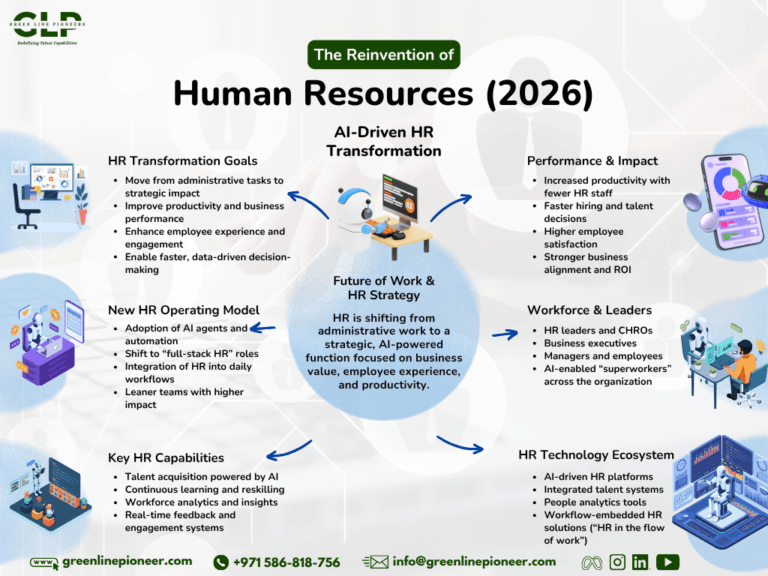
One of the most notable changes is the emergence of AI agents that can handle repetitive tasks. This reduces manual workload and allows HR professionals to focus on strategic priorities, such as shaping company culture and driving organizational change.
Organizations adopting AI at scale are reporting reduced time spent on administrative tasks, improved accuracy in hiring decisions, and faster response times for employee support.
The Emergence of Full-Stack HR Roles
As AI takes over transactional responsibilities, the structure of HR teams is changing. Traditional roles that were highly specialized—like a recruiter who only screens or a coordinator who only handles onboarding—are being replaced by more integrated positions.
These new roles require professionals to combine skills in:
- Data analysis
- Business strategy
- Talent management
- Technology implementation
This shift is often described as the move toward full-stack HR professionals. Instead of working in silos, HR teams are expected to operate across multiple domains, connecting talent strategies directly to business priorities.
As a result:
- HR teams are becoming leaner but more impactful.
- Individual roles carry broader responsibilities.
- Decision-making is becoming faster and more data-informed.
For UAE organizations, this means the demand for a new breed of HR professional is rising, and partnering with experts who can help restructure and upskill your HR function is becoming essential.
HR Embedded in the Flow of Work
Another critical development is the integration of HR into everyday workflows. Rather than operating as a separate function, HR is increasingly embedded within business operations. This is particularly relevant in the UAE’s tech-forward business environment.
This model means:
- Managers have direct access to hiring insights within their workflow tools like Slack or Microsoft Teams.
- Employees receive learning recommendations in real-time while working, not during an annual review.
- Performance feedback becomes continuous rather than periodic, moving away from the outdated annual cycle.
This model reduces friction and ensures that HR support is available when and where it is needed. Organizations adopting this approach are seeing higher employee engagement, more consistent performance management, and improved adoption of HR tools and systems.
Measuring What Matters: From Activity to Outcomes
One of the most important changes in modern HR is how success is measured. In the UAE’s results-driven corporate culture, traditional metrics such as time-to-hire or training completion rates are no longer sufficient.
Organizations are now focusing on outcome-based indicators, including:
- Productivity per employee
- Revenue per employee
- Retention of high-performing talent
- Speed of internal mobility and skill development
This shift requires robust data infrastructure and the ability to connect HR metrics with business performance indicators. Companies that have adopted advanced people analytics are better positioned to identify skill gaps before they impact performance, predict attrition risks, and align hiring strategies with future business needs.
The Concept of the AI-Enabled Workforce
The workforce itself is evolving alongside HR. Employees are increasingly supported by AI tools that help them perform tasks more efficiently. This has led to the concept of the AI-enabled worker, where individuals can achieve higher output with the support of intelligent systems.
In this environment:
- Employees rely on AI for research, analysis, and decision support.
- Managers use data insights to guide team performance rather than relying solely on intuition.
- HR ensures that workers are equipped with the right tools and skills to use AI effectively.
This shift places new responsibilities on HR, particularly in areas such as digital skill development, change management, and the ethical use of AI.
Challenges Organizations Must Address in the UAE
While the transformation of HR presents significant opportunities, it also introduces new challenges that UAE organizations must navigate carefully.
Key concerns include:
- Data privacy and security in AI-driven systems, especially given the UAE’s strict data protection laws.
- Resistance to change among employees and managers who may be accustomed to traditional processes.
- The need for continuous reskilling to keep pace with new technologies.
- Ensuring fairness and transparency in AI-based decisions to maintain trust and avoid bias in a multi-national workforce.
Organizations that fail to address these issues risk undermining the potential benefits of this transformation.
What Business Leaders in the UAE Should Do Next
To remain competitive, organizations need to take a structured approach to HR transformation. Relying on outdated systems or siloed teams will no longer suffice.
Key actions include:
- Invest in AI-driven HR platforms
Adopt technologies that integrate talent management, analytics, and workflow tools. Do not treat HR tech as an isolated purchase; it must connect to your core business operations. - Redesign HR roles and team structures
Move toward broader, more integrated roles that combine business and technical expertise. If your current team lacks these skills, consider leveraging expert HR consulting services to guide the restructuring process and ensure your HR function is built for the future. - Build strong data capabilities
Develop systems that connect HR metrics with business outcomes. Without the ability to analyze data, your organization is flying blind. - Focus on workforce readiness
Ensure employees are equipped with the skills needed to work effectively alongside AI. This includes both technical training and fostering a culture of adaptability. - Integrate HR into business workflows
Embed HR tools and insights directly into daily operations to ensure they are used consistently and effectively.
Conclusion
Human Resources is entering a new phase where its value is defined by measurable business impact. For companies in the UAE, where the business landscape is defined by ambition, speed, and diversity, this reinvention is particularly urgent.
The integration of AI, the evolution of workforce expectations, and the demand for data-driven decision-making are reshaping the function at its core. Organizations that adapt to this change will not only improve efficiency but also create stronger alignment between people strategies and business goals. Those that delay risk falling behind in a landscape where talent, technology, and performance are increasingly interconnected.
The reinvention of HR is not a future possibility. It is already underway, and its implications will shape how organizations operate in the years ahead.
Contact Green Line Pioneers today. Let us help you build a team that is truly ready for the future.
Green Line Pioneers – Your Partner in Strategic HR Consultancy in the UAE
Phone: +971 586-818-756
Email: info@greenlinepioneer.com
Website: www.greenlinepioneer.com
Frequently Asked Questions (FAQs): Team Management in the UAE
In the UAE, AI adoption in HR is often accelerated by the country’s broader national digital transformation strategies. The focus is frequently on managing a highly diverse, expatriate-heavy workforce efficiently, with AI being used to streamline complex visa processes, cross-cultural onboarding, and predictive analytics for retention in a competitive job market.
The primary challenges include ensuring data privacy compliance with UAE regulations, managing the cultural shift for long-term employees accustomed to manual processes, and the initial investment required for high-quality integrated HR platforms that can handle the complexity of multi-national payroll and compliance.
HR professionals must move beyond administrative expertise. The most in-demand skills now include data literacy (ability to interpret people analytics), business acumen (understanding revenue and operational drivers), change management, and technical proficiency in managing HR software and AI tools.
SMEs do not need to build in-house AI systems. They can adopt scalable, cloud-based HR platforms (SaaS) that offer AI functionalities like automated screening and employee self-service. Partnering with an HR consultancy can also provide access to best-practice frameworks and fractional HR leadership without the overhead of a full, specialized internal team.
Focus on metrics that tie directly to business performance: Revenue per Employee, Profit per Employee, Retention Rate of Top Performers, Time to Productivity for New Hires, and Internal Mobility Rate (the speed at which employees are promoted or moved into new roles).

Green Line Pioneers
Redefining Talent Capabilities
Explore us on Social Media