
6 HR KPIs That Truly Measure Your Company's Health in the UAE
For many businesses, Human Resources has traditionally been viewed as an administrative function. However, strategic HR today is a core driver of business success. It shapes company direction, builds resilient, future-ready teams, and has a direct impact on the bottom line.
For HR leaders and C-suite executives in the competitive UAE market, tracking the right metrics is what separates a reactive department from a proactive strategic partner. The right Key Performance Indicators (KPIs) provide a clear picture of your organizational vitality and highlight areas for strategic improvement.
This blog outlines the six most critical HR KPIs that CHROs and HR Heads in the UAE should be monitoring to strengthen their people, refine their processes, and ensure sustainable growth.
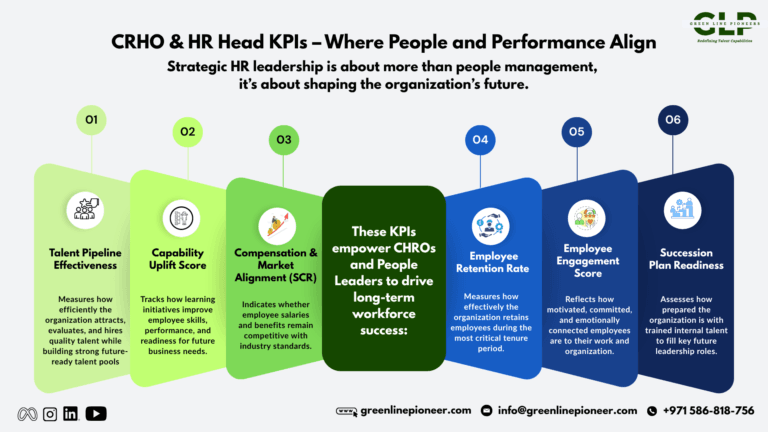
- Talent Pipeline Effectiveness
What it Measures: This KPI evaluates the efficiency and effectiveness of your entire Talent Acquisition process. It goes beyond simple time-to-hire to assess how well you attract, evaluate, and secure qualified candidates, and how robust your pool of potential hires is for critical roles. Effective Talent Acquisition in the UAE requires a pipeline that is both agile and strategic.
Why it Matters for UAE Businesses: The UAE’s dynamic market means competition for top talent is fierce. A weak talent pipeline leads to prolonged vacancies, costly bad hires, and an inability to scale quickly. By measuring this, you ensure your recruitment engine is not just filling seats but building a strategic reserve of skilled individuals, crucial for meeting Emiratisation goals and entering new markets.
- Capability Uplift Score
What it Measures: This tracks the tangible impact of your Learning and Development (L&D) programs. Instead of just measuring training hours, it assesses the actual improvement in employee skills, performance, and readiness for more complex responsibilities or future roles.
Why it Matters for UAE Businesses: With rapid technological adoption and evolving industry standards, continuous upskilling is non-negotiable. This KPI helps justify L&D investments by showing a direct return in terms of a more skilled, agile, and future-proof workforce, which is key to innovation in the UAE.
- Compensation and Market Alignment
What it Measures: This metric checks how competitive your salary and benefits packages are compared to the broader industry and local market in the UAE.
Why it Matters for UAE Businesses: The UAE is a hub for international talent, and compensation expectations are constantly shifting. Falling behind the market can lead to high attrition and an inability to attract the best candidates. Regular analysis ensures your offers are compelling and fair, which is fundamental for employee retention and positioning your company as an employer of choice.
- Employee Retention Rate
What it Measures: This indicates your organization’s ability to keep its employees, particularly during critical tenure periods (e.g., the first year, or after 3-5 years). It is a direct reflection of employee satisfaction and organizational health.
Why it Matters for UAE Businesses: The cost of employee turnover in the UAE considering recruitment, onboarding, and lost productivity is significant. A high attrition rate signals underlying problems with company culture, management, or career progression. Improving this rate directly saves money and preserves institutional knowledge.
- Employee Engagement Score
What it Measures: This score reflects the emotional commitment your employees have to the organization and its goals. It answers whether your team is simply present or is genuinely connected, motivated, and invested in their work.
Why it Matters for UAE Businesses: Engaged employees are more productive, provide better customer service, and are more likely to become company advocates. In a diverse multicultural environment like the UAE, fostering a strong, inclusive culture that drives engagement is a major competitive advantage.
- Succession Plan Readiness
What it Measures: This KPI quantifies your organization’s preparedness to fill key leadership and business-critical roles with capable internal talent. It measures the strength and readiness of your internal bench.
Why it Matters for UAE Businesses: Leadership gaps can derail strategic projects and create instability. For businesses in the UAE, where growth is often rapid, having a clear, actionable succession plan ensures business continuity, secures long-term vision, and motivates high-potential employees by showing a clear path for career advancement.
Conclusion: From Data to Strategic Direction
Consistently tracking these six KPIs transforms HR from a support function into a strategic powerhouse. They provide the data-driven insights needed to build strong, resilient workforce systems designed for long-term success in the UAE’s fast-paced economy.
By focusing on these metrics, you can make informed decisions that not only solve immediate people-related challenges but also proactively shape a thriving and sustainable organization.
Ready to build a data-driven hiring strategy that delivers smart hires?
Green Line Pioneers specializes in optimizing Talent Acquisition for businesses across the UAE. We help you implement these KPIs, interpret the data, and build a robust, efficient hiring engine.
Contact Us Today:
Email: info@greenlinepioneer.com
Phone: +971 586-818-756
Website: www.greenlinepioneer.com
Frequently Asked Questions (FAQs)
While metrics like cost-per-hire are useful for operational efficiency, the KPIs listed here (e.g., Engagement Score, Succession Readiness) provide a deeper, more strategic view of long-term organizational health, sustainability, and growth potential. They focus on outcomes and impact, not just process and cost.
It depends on the KPI. Metrics like Employee Engagement are typically measured annually or bi-annually. However, data like Talent Pipeline effectiveness and Employee Retention should be reviewed quarterly to allow for timely adjustments. A strong Talent Acquisition in the UAE strategy requires constant monitoring of pipeline metrics.
Absolutely. For small and medium-sized businesses in the UAE, these KPIs can be even more critical. A single bad hire or the loss of a key employee can have a much larger impact. Building good measurement habits early sets a strong foundation for scalable growth.
Start by prioritizing one or two KPIs that address your most pressing business challenge. For instance, if you struggle with high turnover, begin by deeply analyzing your Employee Retention Rate and Compensation and Market Alignment. You can gradually incorporate more metrics over time, and partnering with an HR consultancy can provide the necessary expertise.
The most common challenge is data integration and quality. HR data often sits in different systems (payroll, performance, recruitment). The key is to start with the data you have, ensure its accuracy, and build a consistent process for collection and analysis.

Green Line Pioneers
Redefining Talent Capabilities
Explore us on Social Media