
Building for Scale: The 6 Essential HR Pillars for Every Tech Startup in the UAE
In the fast-paced ecosystem of a tech startup, your human resources are not just a support function—they are the very engine of innovation and growth. A reactive, ad-hoc approach to HR can stifle your potential, leading to high turnover, misaligned goals, and cultural chaos.
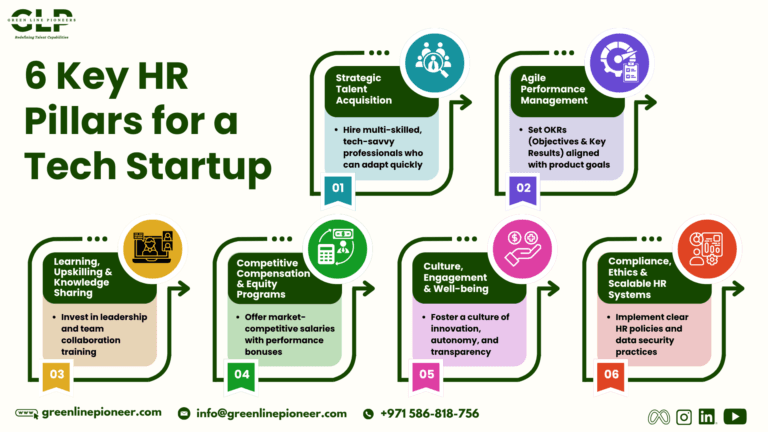
At Green Line Pioneers, we understand that for a tech startup to scale sustainably, it needs a robust, proactive HR foundation. Based on our expertise, we’ve identified the six non-negotiable HR pillars that will help you build, retain, and motivate a world-class team.
- Strategic Talent Acquisition: The Foundation of Your Dream Team
You can’t build a revolutionary product with an ordinary team. For startups, every hire must count. This goes beyond simply filling a vacancy.
The Problem: Startups often hire for a specific, immediate skill gap, without considering long-term needs or cultural fit, leading to a mismatched team that can’t adapt.
The Solution: Strategic Talent Acquisition. This means proactively hiring multi-skilled, tech-savvy professionals who are not just experts but also agile learners. Look for individuals who thrive in ambiguity and are passionate about your vision. A strategic approach to hiring builds a resilient core team that can pivot with the market’s demands.
- Agile Performance Management: Keeping Everyone Aligned and Accountable
Traditional annual reviews are obsolete in a startup environment where priorities shift quarterly, if not monthly. Your team needs clear, dynamic goals.
The Problem: Employees are unsure how their daily work contributes to the company’s big-picture goals, leading to disengagement and wasted effort.
The Solution: Implement an Agile Performance Management system centered on OKRs (Objectives and Key Results). By setting transparent Objectives that are directly aligned with product and company goals, and measuring progress through clear Key Results, you create a culture of focus, accountability, and measurable outcomes. Everyone knows what to do and why it matters.
- Learning, Upskilling & Knowledge Sharing: Fueling Continuous Innovation
The tech landscape evolves daily. The skills that got you here won’t get you there. A stagnant team is a dying team.
The Problem: Rapid growth can cause skill gaps, and top talent leaves if they feel their professional development is stagnating.
The Solution: Create a culture of continuous learning. Invest in upskilling programs, encourage knowledge-sharing sessions, and provide access to learning resources. Crucially, invest in leadership and team collaboration training early. Building strong leaders from within ensures your teams remain productive, cohesive, and innovative as you scale.
- Competitive Compensation & Equity Programs: Attracting and Retaining the Best
While passion drives startups, people have bills to pay. To compete with large tech giants and other startups for top-tier talent, your offer needs to be compelling.
The Problem: Losing star candidates to competitors who offer better financial packages or failing to retain key employees as they seek more lucrative opportunities.
The Solution: Structure Competitive Compensation & Equity Programs. Offer market-competitive salaries supplemented with performance bonuses to reward high achievers. For key roles, consider equity or stock option programs. This not only attracts talent but also aligns their long-term success with the company’s, turning employees into owners.
- Culture, Engagement & Well-being: Building the Heart of Your Startup
Your culture is your company’s personality. It’s what makes people want to come to work every day. A toxic culture is a recipe for burnout and churn.
The Problem: A weak or negative culture leads to low morale, high stress, and poor collaboration, killing creativity and productivity.
The Solution: Intentionally foster a culture of innovation, autonomy, and transparency. Encourage calculated risk-taking without fear of failure. Promote psychological safety and prioritize employee well-being through flexible work arrangements and mental health support. An engaged employee in a positive culture is your most powerful brand ambassador.
- Compliance, Ethics & Scalable HR Systems: The Unseen Backbone
As you grow from 10 to 50 to 100+ employees, what worked informally will start to break. Manual processes and unclear policies create massive legal and operational risks.
The Problem: Founders are bogged down with administrative HR tasks, and the company is exposed to compliance risks, especially under UAE labour law.
The Solution: Proactively implement clear HR policies and data security practices. Establish a scalable HR system from the start to manage employee data, payroll, and benefits efficiently. Uphold the highest ethical standards and ensure data security is a priority. This pillar may not be glamorous, but it’s what allows all the other pillars to function smoothly and securely as you scale.
Ready to build a future-proof team? At Green Line Pioneers, we specialize in helping UAE tech startups implement these essential HR pillars to drive sustainable growth. Let’s build your competitive advantage together.
Contact Us Today:
- Website: greenlinepioneer.com
- Email: info@greenlinepioneer.com
- Phone: +971 586-818-756
Frequently Asked Questions (FAQs)
A strong HR foundation is not about bureaucracy; it’s about building a scalable operating system for your people. It directly impacts your ability to attract top talent, maintain a productive and innovative culture, and avoid costly legal missteps, which are all vital for survival and growth.
The most common mistake is delaying the implementation of clear HR systems and UAE labour law-compliant policies until a problem arises. Being proactive with contracts, policies, and performance management frameworks from day one saves immense time, money, and stress later.
While cash is king, a total rewards package is more than just salary. Startups can leverage equity (stock options), performance bonuses, a fantastic culture, professional development opportunities, and flexible working arrangements to create a compelling offer that rivals larger companies.
KPIs (Key Performance Indicators) are health metrics for ongoing processes—they measure how well you are doing something. OKRs (Objectives and Key Results) are a goal-setting framework for ambitious, measurable change—they define what you want to achieve and how you’ll know you’ve achieved it. Startups use OKRs to drive focused growth.w

Green Line Pioneers
Redefining Talent Capabilities
Explore us on Social Media