
The HR Life Cycle: Transforming Silos into Strategy for Powerful Business Results
Most HR departments operate like a collection of isolated islands: Recruitment does its thing, Learning & Development runs its programs, Compensation designs its plans, often with minimal connection. The result? Fragmented efforts, inconsistent employee experiences, and talent strategies that fail to fully ignite business success. High-impact organizations, however, view HR through a different lens: as an integrated, strategic life cycle.
This holistic HR Life Cycle isn’t just a process map; it’s the blueprint for connecting your talent strategy directly to tangible business outcomes. When each phase consciously informs and fuels the next, HR transcends its administrative roots and becomes a powerful engine for growth, innovation, and competitive advantage.
Why the Silo Approach Fails (and Why the Life Cycle Wins):
- Disconnected Efforts: Actions in one area (e.g., hiring) don’t consider downstream impacts (e.g., development, retention).
- Inconsistent Experience: Employees experience jarring transitions between different HR touchpoints.
- Reactive Mindset: HR spends time plugging leaks rather than building a resilient talent pipeline.
- Missed Strategic Impact: Talent initiatives fail to demonstrably move the needle on core business goals.
The Integrated HR Life Cycle: Your Strategic Blueprint
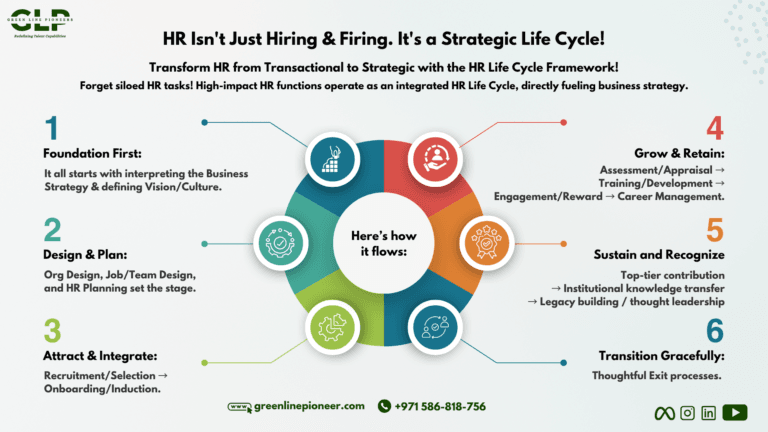
Imagine a continuous loop where every stage builds upon the last, creating a seamless flow of talent and strategy. Here’s how it works:
- Phase 1: Foundation – Aligning Talent with Purpose
- What: This is the bedrock. It starts with deeply understanding the business strategy, the company vision, and the core culture you need to succeed. It’s about translating business objectives into clear talent implications.
- Why it Matters: Without this strategic alignment, all subsequent HR efforts risk being misdirected or irrelevant. It ensures talent strategy drives business goals, not the other way around.
- Key Activities: Strategic workforce planning alignment, defining core values and cultural pillars, leadership buy-in on talent priorities.
- Consequence of Neglect: HR initiatives feel disconnected from the “real work,” lack leadership support, and fail to contribute meaningfully to organizational success.
- Phase 2: Design & Plan – Building the Architecture for Success
- What: Based on the foundation, design the optimal organizational structure. Define roles and teams clearly. Engage in proactive workforce planning to identify future talent needs and potential gaps.
- Why it Matters: Structure enables or hinders performance. Clear roles and planning ensure you have the right people, in the right places, with the right skills, at the right time to execute the strategy.
- Key Activities: Organizational design, job analysis and description creation, competency framework development, skills gap analysis, strategic workforce planning scenarios.
- Consequence of Neglect: Bureaucracy stifles agility, role confusion leads to conflict, and unexpected talent shortages derail projects.
- Phase 3: Attract & Integrate – Making Powerful First Impressions
- What: Execute strategic recruitment to find individuals who align with your culture and possess the needed skills and potential. Follow this with intentional onboarding designed to rapidly integrate new hires into the team, culture, and their roles.
- Why it Matters: Selective hiring ensures quality and cultural fit. Effective onboarding dramatically increases time-to-productivity, boosts early engagement, and significantly improves retention rates. First impressions forge lasting commitment.
- Key Activities: Employer branding, targeted sourcing, competency-based interviewing, structured onboarding programs (covering culture, role, and relationships), buddy/mentor systems, early goal setting.
- Consequence of Neglect: High cost-per-hire, poor quality hires, slow ramp-up times, early turnover, and disengaged newcomers.
- Phase 4: Grow & Retain – Unleashing Potential and Building Loyalty
- What: This is the heart of the employee journey. Implement fair and developmental performance management. Provide continuous learning and development opportunities. Offer meaningful rewards and recognition tied to contributions and values. Design clear career paths.
- Why it Matters: Employees stay and thrive where they feel valued, see growth opportunities, and are fairly assessed. Developing internal talent is often more efficient and effective than constant external hiring. Career paths transform potential into long-term contribution.
- Key Activities: Regular feedback conversations (not just annual reviews), personalized development plans, diverse training modalities (mentoring, coaching, courses), equitable compensation and benefits structures, non-monetary recognition programs, transparent career progression frameworks.
- Consequence of Neglect: Stagnation, skills obsolescence, high turnover (especially of top performers), disengagement, and loss of competitive edge.
- Phase 5: Sustain & Recognize – Honoring Experience and Securing Critical Talent
- What: Proactively identify and nurture mission-critical talent. Capture and leverage institutional knowledge from experienced employees. Celebrate legacy builders and those embodying core values deeply. Implement strategies to retain high performers at their peak contribution stage.
- Why it Matters: Losing critical expertise is costly. Recognizing deep experience fosters loyalty and motivates others. Purposefully retaining top talent in key roles ensures stability and continuity of strategic execution.
- Key Activities: Succession planning for critical roles, knowledge transfer programs (mentoring, documentation), specialized retention strategies for key talent, long-service awards, recognition programs focused on impact and values.
- Consequence of Neglect: Loss of irreplaceable expertise, brain drain, decreased morale among tenured staff, vulnerability in key positions.
- Phase 6: Transition Gracefully – Ending with Respect, Beginning Anew
- What: Manage all departures – voluntary or involuntary – with respect and professionalism. Conduct meaningful exit interviews to gather insights. Preserve positive relationships and build alumni networks.
- Why it Matters: How you handle exits impacts employer brand, morale of remaining staff, and future re-hiring potential. Alumni can become brand ambassadors, customers, or even boomerang employees. Exit data provides invaluable feedback for improving the life cycle.
- Key Activities: Respectful offboarding processes, structured exit interviews focused on learning, knowledge transfer planning, maintaining alumni networks (events, communications), celebrating contributions upon departure.
- Consequence of Neglect: Damaged employer reputation, loss of valuable feedback, disgruntled former employees, missed opportunities for future collaboration.
The Transformative Power of the Integrated Cycle:
Adopting this holistic HR Life Cycle perspective fundamentally changes the game:
- HR Becomes a Strategic Driver: Moves beyond administrative support to actively shaping business outcomes through talent. HR earns a seat at the strategic table.
- Employees Experience Cohesion: Talent processes feel connected and purposeful, not fragmented. This boosts engagement, trust, and the overall employee experience (EX).
- Business Goals & Talent Strategy Converge: Talent initiatives are directly derived from and measured against business objectives, creating demonstrable ROI for HR investments. Performance improves across the board.
- Proactive Talent Management: The cyclical nature encourages foresight and planning, reducing reactive firefighting.
The Critical Question: Where Does Your Cycle Break?
The power lies in the flow. A breakdown in any single phase weakens the entire system. Conduct an honest audit:
- Are your recruitment efforts truly aligned with the long-term culture defined in Phase 1?
- Does your onboarding (Phase 3) effectively set people up for the growth planned in Phase 4?
- Are exit insights (Phase 6) systematically fed back to improve attraction, culture, or role design (Phases 1, 2, 3)?
- Is performance management (Phase 4) genuinely informing development and succession planning (Phase 5)?
Embrace the Cycle, Unleash Your Talent Strategy
Viewing HR as an integrated life cycle is not just an operational shift; it’s a strategic imperative. By breaking down silos and ensuring each phase seamlessly informs the next, you create a powerful, self-reinforcing system that directly connects your people strategy to your most critical business outcomes. Stop managing disparate functions. Start orchestrating the talent lifecycle. The future of high-impact HR is integrated, strategic, and results-driven.

Green Line Pioneers
Redefining Talent Capabilities
Explore us on Social Media